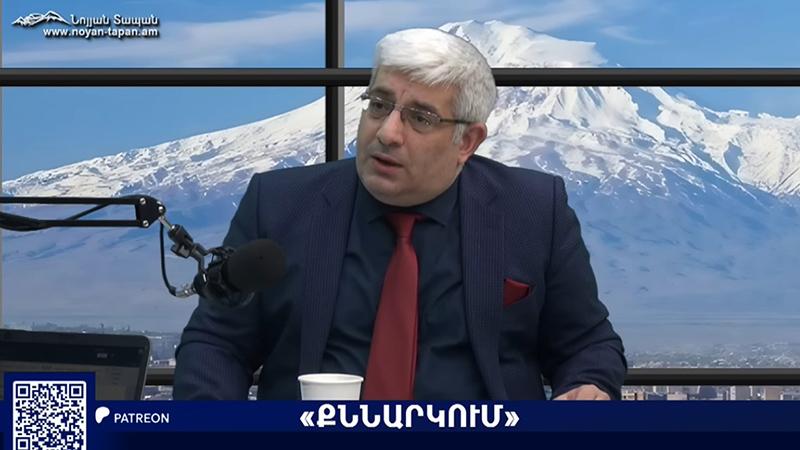
The Architecture of Autonomy: Edgar Vardanyan on Armenia’s Quest for Strategic Depth
31-03-2026 18:05:21 | Armenia | Interviews
In a period marked by profound geopolitical shifts and a fundamental re-evaluation of national security, the discourse surrounding Armenia’s independence has moved from abstract rhetoric to a critical assessment of state survival. In a recent extensive interview hosted by Noyan Tapan, political scientist and associate expert of the Armenian Council, Edgar Vardanyan, provided an in-depth analysis of the current administration’s claims of increased sovereignty and the precarious nature of international guarantees.
The discussion opened with a reflection on Prime Minister Nikol Pashinyan’s frequent assertions that Armenia is more independent today than at any point in its modern history. While critics often view such statements through a partisan lens, Vardanyan suggested that the reality lies in the structural diversification of the country’s foreign policy.
“Independence is not merely a declaration; it is the functional capacity of a state to make decisions based on its own national interests without being held hostage by a single center of power,” Vardanyan noted during the session. He argued that the transition from a mono-vector dependence toward a more balanced, multi-faceted engagement with global actors is the primary indicator of this growing autonomy.
The End of the Security Monopoly
For decades, Armenia’s security architecture was predicated on a singular alliance. However, the events of recent years have exposed the vulnerabilities of this model. Vardanyan emphasized that the current government's efforts to seek new partners in the West and beyond are not merely "anti-Russian" moves, as often characterized by opponents, but are instead a necessary pursuit of "strategic depth."
According to Vardanyan, the previous status quo offered a false sense of security that eventually led to stagnation. By opening the floor to diverse international interests, Armenia is attempting to create a "web of interdependence" that makes the cost of aggression higher for regional adversaries.
“When multiple international players have stakes—whether economic, political, or security-related—in the stability of a nation, that nation gains a layer of protection that no single treaty can provide,” Vardanyan explained.
The Fragility of Guarantees
A significant portion of the interview focused on the concept of "guarantees" in a volatile neighborhood. With the ongoing tensions with Azerbaijan and the unpredictability of Baku’s long-term political trajectory, the question remains: can Armenia ever truly feel secure?
Vardanyan was pragmatic in his assessment, warning against the illusion of absolute safety. “Such guarantees never exist in their final form,” he stated. “We can never fully discount the possibility of a change in government in Azerbaijan or a sudden shift in their policy. History shows that today’s promises can become tomorrow’s relics.”
Instead of looking for a "paper shield," Vardanyan argued that Armenia’s best defense is the "interconnection of interests." He highlighted that the current level of international involvement in the region—ranging from EU monitoring missions to increased diplomatic pressure from Washington and Paris—serves as a functional deterrent.
A Pivot toward the Future
Concluding the discussion at Noyan Tapan, Vardanyan stressed that the path to real independence is fraught with short-term risks but remains the only viable route for long-term statehood. The transition from being a "client state" to an "active participant" in regional geopolitics requires a level of internal resilience and diplomatic agility that Armenia is only beginning to master.
“The guarantees we seek are not found in the goodwill of others, but in the complexity of the global interests we manage to align with our own,” Vardanyan concluded.
As Armenia continues to navigate this high-stakes diplomatic landscape, the insights provided by experts like Vardanyan underscore a pivotal moment in the nation’s history: a move away from the shadows of the past toward a sovereignty defined by engagement, diversification, and the cold reality of international politics.









 ENGLISH
  Հայերեն
 Русский
 Դաս. հայերեն
 French