

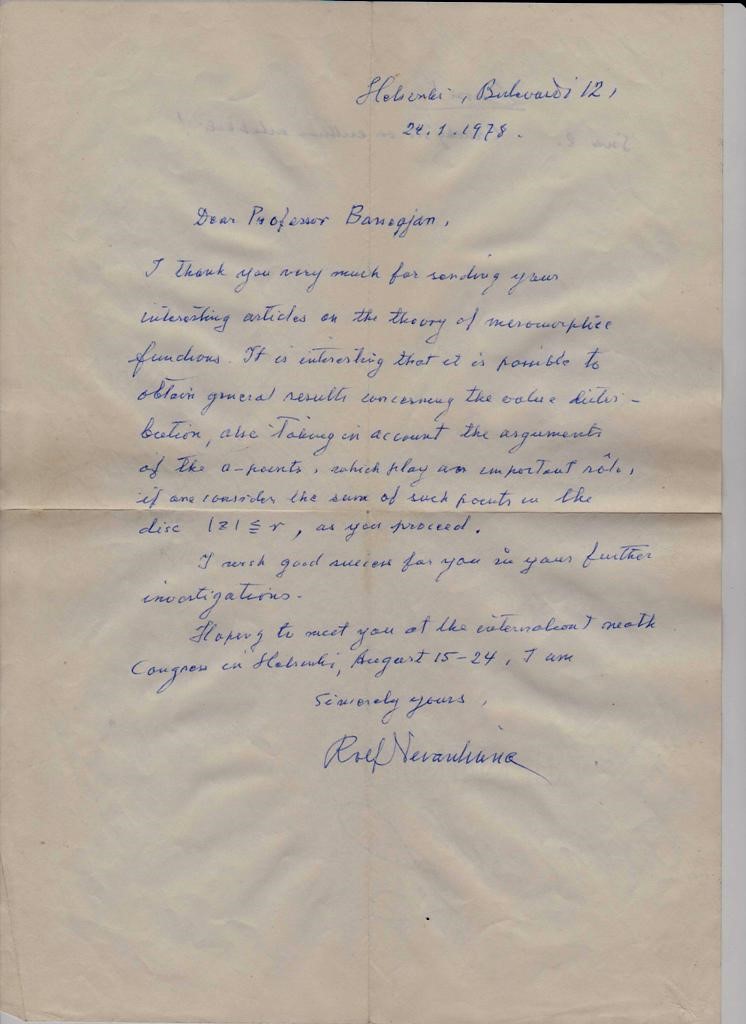
Цитирование первое:
письмо Президента Меж
дународного Математического Общества Р. Неванлинна 1978 года.
Цитирование второе: касающиеся теории комплексных сумм а-точек.
"Russian Math. Survey Journal", a review on the paper published in 1977:
Barsegian G., Distribution of sums of a-points of meromorphic functions, Dokl. Acad. Nauk SSSR, V. 234, n. 4, 1977, p. 761-763.
...The author has constructed a theory that takes into account not only quantities of a-points (as theories of Nevanlinna and Ahlfors) but also their geometric locations...
Reviewed by V. P. Petrenko (Chair of mathematical analysis in Kharkov University)
Цитирования третье: касающееся “теории близости а-точек”.
Мы приводим ниже 3 цитирования.
3.1.
«Zentralblatt», review 0602.30037 on the paper published in 1985:
Barsegyan, G.A., The proximity property of the a-points of meromorphic functions and the structure of univalent domains of Riemann surfaces. I. (Russian, English), Sov. J. Contemp. Math. Anal., Arm. Acad. Sci. 20, No.5, 50-76 (1985); translation from Izvestia Akad. Nauk Arm. SSR, Mat. 20, No.5, 375-400 (1985).
...The fundamental results of this interesting paper are results on cercles de remplissage... Nevertheless, they allow to strengthen in an essential manner L. Ahlfors' first and second fundamental theorems of the theory of covering surfaces, the second fundamental theorem of R. Nevanlinna's theory, the deficiency relation of L. Ahlfors and R. Nevanlinna, showing that the basic conclusions of the theory of the distribution of values are part of a theory having a more general regularity: the "proximity property of the a-points" of meromorphic functions. Theorems 1.1 and 1.2 from the paper give sharp estimate of the cercles de remplissage.
Reviewed by A. Klijc (Full professor, former dean of Prague University)
3.2.
«MathSciNet», review MR1680525, (2000d:30041) on the paper published in 1997:
Barsegyan, G. A., Applications of the principle of partitioning of meromorphic functions. I. The comparability property. (Russian. English, Russian summaries), Izvestia Natcionalnoi Akad. Nauk Armenii Mat. 32 (1997), no. 3, 5--50 (1998); translation in J. Contemp. Math. Anal. 32 (1997), no. 3, 2--45 (1998).
…In his earlier works the author has built a theory which in particular establishes that the sets of a-points of a meromorphic function are geometrically close to each other for the majority of a. The introduction of the present paper contains the main definitions and principles of the theory… .
Reviewed by Alexander Ulanovskii (Full professor)
3.3.
7. «MathSciNet», review MR3155676 30D35 on the paper published in 2013:
Barsegian, G. Revisiting a general property of meromorphic functions, Complex analysis and dynamical systems V, 45{49, Contemp. Math., 591, Israel Math., Conf. Proc., Amer. Math. Soc., Providence, RI, 2013.
In the classical theories of R. Nevanlinna and L. Ahlfors the number of a-points of a meromorphic function is most important. The other aspect of nearness or proximity of a-points, which may play a vital role in studying the value distribution of a meromorphic function, is not in general taken care of in the above-mentioned theories. In 1978, some proximity properties were established by G. A. Barsegyan [Dokl. Akad. Nauk SSSR 238 (1978), no. 4, 777- 780 (MR0466554]..
Reviewed by Indrajit Lahiri
Цитированиечетвертое: касающеесятеорииГамма-линий.
С конца 1970-ых было много писем и высказываний, оценивающих Гамма-линии как новую теорию. Ниже мы приводим 4 цитирования.
Наиболее полное описание дал Heinrich Begehrв следующей рецензии на книгу 2002-го года.
4.1.
«MathSciNet», review MR2002433 (2005f:30001) on the book published in 2002:
Barsegian, Grigor A. Gamma lines. On the geometry of real and complex functions. Asian Mathematics Series, 5., Taylor &Francis, London, 2002, 176 pp.
.... the theory of Gamma-lines presented here is a generalization of the classical value distribution theory…
... An essential element of the theory of Gamma-lines is the tangent variation principle
[G. A. Barsegyan, Izvestia Natcionalnoi Akad. Nauk Armenii Mat. 27 (1992), no. 3, 39--65 (1993); MR1327603 (96a:30025)]…
... This theory of Gamma-lines is a beautiful application of geometrical considerations in complex analysis, generalizing and supplementing the classical value distribution theory for meromorphic functions. It will lead to further insights into complex analysis.But it seems to be applicable to much wider function classes, even to real-valued functions, and thus will be interesting also for applied mathematicians.
Reviewed by Heinrich Begehr (former president of the International Society of Analysis its Applications and Computations, director of Math. Institute in Free University Berlin)
4.2.
«MathSciNet», review MR2141750 (2006b:34198) on the paper published in 2005:
Barsegian G. , Le D. T., On a topological description of solutions of complex differential equations. (English summary), Complex Variables, Theory Appl. 50 (2005), no. 5, 307--318.
…This paper offers a topological-analytic approach to the behavior of single-valued solutions ... of certain complex differential equations with possibly multi-valued coefficients. The proofs make use of the gamma-line theory due to the first author [see Gamma lines, Taylor &Francis, London, 2002; MR2002433 (2005f:30001)]...
Reviewed by Ilpo Laine (Former dean of Joensuu University, member of the council of European Universities).
4.3.
From recommendations for International Ambartsumian Prize.
Prof. Dr. Heinrich Begehr: (former president of the Berliner mathematical society, former president of the International Society for Analysis its Applications and Computation-ISAAC Society.
... His (Barsegian's) theory of Gamma-lines does not only complement classical value distribution theory but also has applications in many areas of mathematics and mathematical physics. The reason is that Gamma-lines are related to level lines. Level lines play a crucial role in many areas of science like mathematical physics, meteorology, geosciences, biosciences, even in economy. Thus the applications of the theory of Gamma-lines go far beyond mathematics. But it has a wide influence even in mathematics beyond complex analysis. Grigor Barsegian was able to extend his investigation from meromorphic functions to real-valued functions as harmonic functions, solutions to differential equations, real polynomials in several variables but also to complex polynomials, curves in differential geometry, in integral geometry, algebraic curves in algebraic geometry.
When David Hilbert developed his idea of a later so-called "Hilbert" space in connection with the theory of integral equations it was not immediately clear how important this concept will later prove to be in mathematics and in physics. Grigor Barsegian's theory of Gamma-lines has already gained wide application in mathematics and it is obvious that it will have impact in mathematical physics and other sciences. Therefore, he is a strong and honorable candidate for the Viktor Ambartsumian Prize. It is a pleasure and also a duty for me to recommend Grigor Barsegian with all my heart for the prize.
4.4.
Prof. Dr. George Csordas, (recipient of the Medal of the Board of Regents).
Professor Barsegian is one of the leading complex function theorists in the world and his research in the Nevanlinna theory ranks him among the top in his field...
The profound significance of his work, especially in the area of the Nevanlinna theory and in general value distribution theory, has pushed these fields ahead on a number of key occasions. In his recent book, Gamma-lines: On the geometry of real and complex functions, he presents a novel and exciting program of mathematical studies. Using his theory of Gamma-lines (especially, value distribution theory, proximity properties, and level sets), he establishes new and surprising connections between partial differential equations, ordinary and elliptic complex differential equations, boundary value problems and several areas of applied mathematics and physics...
The creative aspects of Dr. Barsegian's theory of proximity property and Gamma-lines are not confined to extensions of the Nevanlinna and Ahlfors theories of meromorphic functions. The remarkable fact is that his generalizations of the classical theory led him to the successful investigation of the level sets of arbitrary smooth real functions u(x,y) (see the article entitled Turbulence of Real Functions). The importance of these results lies not merely in the domain of pure mathematics. Indeed, the exciting ramifications pertain to a number of significant applications in applied areas; notably in physics. In conclusion, Dr. Barsegian's seminal work provides a new framework and direction in theoretical research and adumbrates novel applications, in physics, astronomy as well as in a number of applied sciences. Therefore, in recognition of his more than 30 years of sustained, outstanding lifetime achievements, I strongly recommend that he be awarded the Viktor Ambartsumian International Prize.
Цитирование пятое: касающееся классической теории.
Тhe European Scientific Council, which evaluated my proposal for the Marie Curie Award (scholarship, € 300,000), wrote the following.
"The applicant (Barsegian) is a highly creative mathematician, one of the leading complex function theorists".
"The application of a (rather classical, for today) theory developed by the applicant to new areas will probably lead to new results".
"The applicant's activities reflect initiative, independent thinking and leadership qualities".




 РУССКИЙ
  Հայերեն
 English
 Դաս. հայերեն
 French