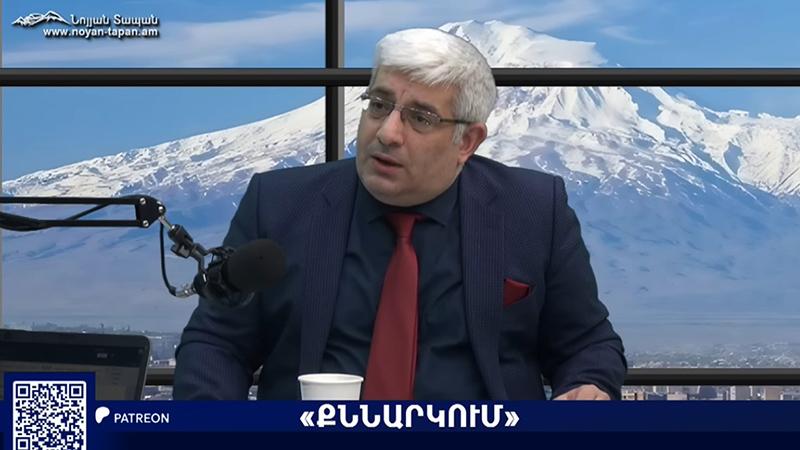
Recipes for healing an ailing government and society.
Grigor Barseghyan
Chairman of the Council of Armenian Specialists, Doctor of Sciences,
Recipient of the Marie Curie International Scientific Award
At various times, many renowned scholars have characterized the Armenian people.
In this article, I will present my opinion (as a scholar) on what ails the Armenian people and how to strengthen them. We offer not poetic assessments or metaphors, but concrete steps that the people, the government, and the opposition must take to create a strong state.
Point 1. Neither the government nor the opposition has even the slightest understanding
of the state's mission.
Have you ever wondered why so much attention has been paid throughout history to the legitimacy and continuity of power (pharaohs, kings, sultans, shahs)? The explanation is very simple. Only under great rulers were professional communities capable of governing countries formed (priests, sages, viziers, and the like). Therefore, the primary issue was the legitimacy and continuity of power, because only in this way could professionalism in state governance be achieved; only in this way could the knowledge of statecraft be preserved.
Ordinary people in the old days were too far removed from all this.
Fortunately, in the old days, when war was the main occupation, military professionals were identified quite simply: people saw who fought well.
In modern times, the situation has changed radically. Already in Bismarck's time, it was understood that school reform was a far greater determinant of a state's strength (and even its military potential).
Moreover, in modern times, a state's strength was determined by the number of professionals involved in state governance in a wide variety of spheres.
Now let's look at what state governance is like in Armenia.
After the USSR, the state in Armenia did not engage in the most significant spheres of activity: industry and agriculture. This was the responsibility of local oligarchs, the wealthy, and the people. The state was solely concerned with science, military affairs, and public administration. It also partially occupied itself with medicine and banking.
It should be noted here that the state's attention should have been focused primarily on science and military affairs; these account for 80 percent of its importance.
Therefore, Armenia is 80 percent dependent on how well professional officials are selected
in science and military affairs.
This, in turn, means that Armenia is 80 percent dependent on how well the government understands
what professionalism in science and military affairs means.
In other words, everything depends on whether the government understands what the ranking system in science and military affairs is.
Now let's see if Armenia understands the importance of selecting professionals.
Let's start with the fact that, under all post-Soviet rulers of Armenia, the understanding of professionalism (the rating system) was either unsystematic (chaotic) or completely anti-state.
To characterize and describe these processes, we will use the phrase "unprincipled managerial rabble," referring to people who are completely unsuited to governing this field and lack any ideas. Note that such rabble can even hold academic degrees.
So, under all Armenian rulers, the bureaucracy was recruited primarily from unprincipled managerial rabble.
Such bureaucrats have a vested interest in incorrect decisions within the state, in the wrong criteria, for the simple reason that any correct decision must, first and foremost, require the removal of such rabble from power.
Thus, this rabble has a vested interest in the internal genocide of the Armenian people. See my article: "Internal Genocide in Armenia (full version)", https://nt.am/ru/news/332897/
Let's consider, for example, the situation in science. Absurd criteria, forcibly imposed by the administrative rabble, are currently in effect here, or, rather, no criteria are in effect at all. The fact that the existing criteria are absurd, even criminal, can be seen in my article:
"On the Multifaceted Crimes in Science in Armenia. Pashinyan Must Launch an Appropriate Investigative Process against the Science Committee", https://nt.am/ru/news/351114/
What conclusion do we reach?
A country (the government, the opposition, the people) is incapable of functioning if the criteria for professionalism in various fields are not developed and understood. Clearly, after understanding the criteria for professionalism, it is necessary to identify the country's professionals.
It must be emphasized that neither the government nor the opposition have any idea of this professionalism. And the stated criteria of professionalism are often not at all obvious.
Our first key prescription for healing the country concerns precisely the development of criteria of professionalism.
What should be our next steps?
Currently, Armenia is a country where not a single sound idea will be implemented.
Imagine a situation where some cosmic or heavenly force brings the best possible advice to Armenia in a wide variety of fields. The question is, what will happen in Armenia? What will change for the government or the opposition? You can be sure that no one in the government or the opposition will heed such cosmic or heavenly advice. Why? It's very simple. Both the government and the opposition are largely composed of non-professionals, for whom any correct decision in the country is perceived as a threat to their personal well-being.
Therefore, we need to implement mechanisms in the country that can compel the authorities to follow the advice of professionals.
Our second key prescription for healing the country concerns developing mechanisms that compel the country to listen to the opinions of professionals.
Armenia could become the first small country in the world to be governed by professionals if it applies the first and second key principles outlined above.
To be continued.






 ENGLISH
  Հայերեն
 Русский
 Դաս. հայերեն
 French