Sovereignty on the Ballot: Armenia’s Election and the Clash of Global Orders
20-05-2026 20:00:10 | Հայաստան | Հարցազրույցներ
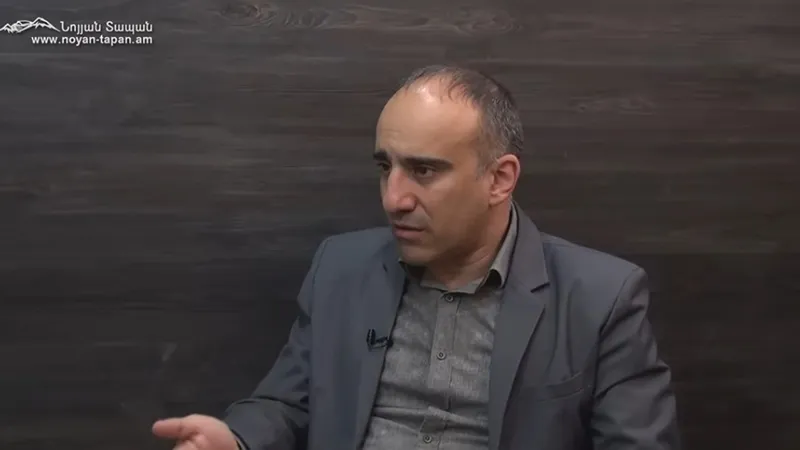
In an insightful analysis broadcast by the prominent media outlet Noyan Tapan, political scientist Robert Ghevondyan, an expert with the Armenian Council NGO, provided an incisive breakdown of Armenia's domestic electoral landscape against a backdrop of major global shifts. Ghevondyan framed the upcoming national ballots not merely as a local political contest, but as an existential crossroads operating within a broader confrontation between democratic and authoritarian world orders.
The Global Duopoly and Regional Corridors
Ghevondyan began by placing recent high-profile international diplomacy within the framework of a global duopoly dominated by the United States and China. Rather than absolute hostility, their relationship is defined by a paradoxical blend of strict competition and deep economic interdependence. "They are two superpowers... they cannot simply oppose or cooperate with one another; there are areas where they are forced to cooperate," Ghevondyan observed.
This superpower rivalry mirrors down to the South Caucasus, impacting critical transit infrastructure. According to Ghevondyan, while Beijing maintains infrastructure dominance over the transit branches crossing Azerbaijan and Georgia, the alternative logistical branch transiting through Armenia aligns far more closely with Western frameworks and U.S. strategic logic. For smaller regional nations, managing these overlapping interests is essential to preventing catastrophic friction.
The Geopolitical Reality of Pre-election Rhetoric
Turning to domestic affairs, the Noyan Tapan host highlighted a notable contradiction: while independent analysts view the upcoming election as heavily geopolitical, Prime Minister Nikol Pashinyan has publicly downplayed this subtext.
Ghevondyan strongly disputed the Prime Minister's characterization, arguing that the ruling party’s own campaign narratives expose the fallacy. "Pashinyan claims that if the Civil Contract party is not returned to power, there will be war. This is entirely geopolitical," Ghevondyan remarked. For a vulnerable state in a volatile neighborhood, any internal political shift that directly alters the risk of military conflict is inherently tied to global power dynamics.
Democracy vs. Totalitarian Authoritarianism
According to the analyst, the fundamental choice facing voters is between democracy and a return to authoritarianism. He warned that the ascension of any pro-Russian faction would plunge Armenia into a brand of autocracy significantly harsher than the pre-2018 system, as a new leadership would systematically dismantle civil liberties to guarantee it never faces another popular uprising.
Addressing critics who claim the current administration is sliding into dictatorship, Ghevondyan offered a robust defense of Armenia's civic health. "The mere fact that individuals can appear on television and openly call Pashinyan a dictator proves that democracy exists," he stated, drawing a stark contrast with the absolute suppression of dissent seen in the Russian Federation.
Campaign Strategies and the Kremlin Factor
Ghevondyan characterized the aggressive, often polarizing rhetoric on the campaign trail as a deliberate strategy to capture undecided, less-informed voters through emotional manipulation. He noted distinct tactical maneuvers within the opposition, pointing out how former President Robert Kocharyan used confrontational posturing to siphon pro-Russian votes away from rivals like tycoon Samvel Karapetyan. Meanwhile, other veteran figures like Gagik Tsarukyan operate out of pure pragmatism, waiting to see who wins to protect their extensive business interests.
Regarding escalating pressure from Moscow and Vladimir Putin's explicit warnings that membership in the Eurasian Economic Union (EAEU) is incompatible with European integration, Ghevondyan concluded that a democratic confirmation of the current administration would ultimately force the Kremlin to relent. "Russia will reckon with the results, and these attacks against Armenia will significantly weaken," Ghevondyan stated, emphasizing that Russia’s own geopolitical interests will eventually compel it to adapt to a democratically validated Armenian government.


 ՀԱՅԵՐԵՆ

 Русский
 English
 Արեւմտահայերեն
 French