Beyond the Mirage: Why Armenia’s ‘Era of Peace’ Risks Colliding with Global Reality
26-02-2026 16:35:58 | Armenia | Interviews
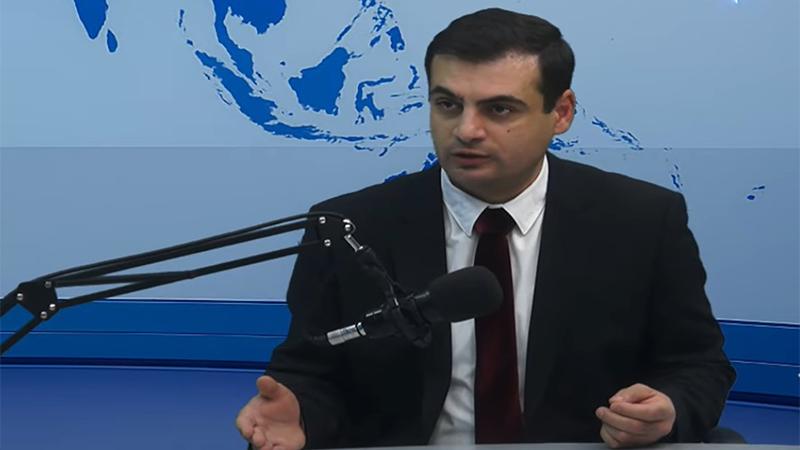
YEREVAN — In a recent and stirring interview hosted by the Noyan Tapan media center, Gurgen Simonyan, Chairman of the Democratic Party of Armenia and a Doctor of Political Science, laid out a sobering vision for Armenia’s future. Amidst a backdrop of shifting global alliances and regional volatility, Simonyan used the platform to announce a new political consolidation and to cast a critical eye on the government’s current "Era of Peace" narrative.
A New Alliance for "Healthy Forces"
The interview began with a significant political announcement. Simonyan revealed that his party has entered into a formal memorandum of cooperation with noted political scientist Edward Antinyan. This move, Simonyan explained, is part of a broader effort to unify "healthy political forces" in Armenia.
"We are seeking to create a platform for those who prioritize statehood and professional political analysis over populist rhetoric," Simonyan noted. The alliance suggests a growing movement among the Armenian intelligentsia and centrist politicians to provide an alternative to the current administration’s trajectory, which they argue lacks the strategic depth required for the present crisis.
The Fragility of the "Era of Peace"
The crux of Simonyan’s critique centered on the Armenian government’s frequent promises of an impending "Era of Peace." In a sharp geopolitical analysis, Simonyan argued that such claims are not only premature but potentially dangerous when divorced from the reality of the Middle East and the Caucasus.
Drawing attention to the escalating tensions between the West—led by the United States—and the Islamic Republic of Iran, Simonyan painted a grim picture of how a regional conflict could dismantle Armenia’s domestic plans.
"The authorities continue to sing the same song: that borders will open and Chinese goods will flow freely through our territory," Simonyan remarked. "But what happens if a war breaks out? If there is a civil conflict or a regional war involving our neighbors, do we truly believe that military convoys or warring factions will simply stop and respect Armenia’s 'peace zone' because we decided it was so?"
Simonyan’s discourse at Noyan Tapan served as a masterclass in geopolitical realism. He challenged the notion that Armenia can unilaterally declare peace in a region where the interests of superpowers and regional giants are in direct collision. He suggested that the Armenian leadership is operating under a set of assumptions that do not account for the "mordant" nature of modern warfare or the unpredictability of the Iranian-Western standoff.
According to Simonyan, the "Era of Peace" narrative acts more as a sedative for the public rather than a functional foreign policy. He argued that instead of passive optimism, Armenia requires a robust, proactive strategy that prepares the nation for the possibility of being caught in the crossfire of a much larger global struggle.
As the interview concluded, the message was clear: the political landscape in Armenia is shifting. The cooperation between Simonyan and Antinyan represents a hardening of the opposition’s intellectual front. For the viewers of Noyan Tapan, the discussion served as a reminder that in the volatile theater of South Caucasian politics, peace is rarely something that can be found in a slogan; it must be secured through calculated diplomacy and a clear-eyed understanding of the world’s most dangerous fault lines.
Whether the "healthy forces" Simonyan spoke of can successfully steer the national conversation remains to be seen, but his warnings have certainly added a layer of urgency to the political discourse in Yerevan.




 ENGLISH
  Հայերեն
 Русский
 Դաս. հայերեն
 French