The Neural Frontier: Deconstructing the Hybrid Siege of the Armenian Consciousness
23-03-2026 15:46:22 | Armenia | Interviews
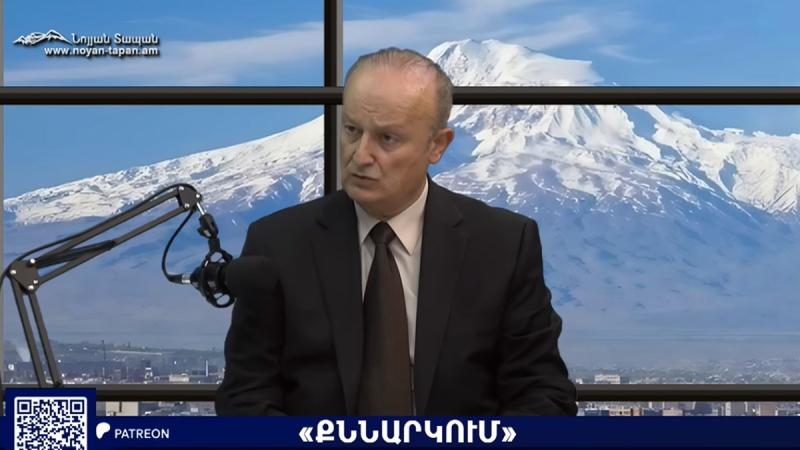
In a recent in-depth discussion on the Noyan Tapan platform, Dr. Hayk Trunyan, a Candidate of Sociological Sciences, laid bare a chilling reality: the most critical battlefield for modern Armenia is no longer just its physical borders, but the minds of its citizens. As the nature of conflict shifts from kinetic strikes to "cognitive warfare," Trunyan warns that the tools of social engineering are being deployed with surgical precision to reshape the Armenian national identity from the inside out.
Beyond Propaganda: The Rise of the Social Engineer
According to Dr. Trunyan, the world has moved past traditional psychological operations into an era of cognitive war. While old-school propaganda focused on what people think, cognitive warfare targets how they think. This transition is fueled by "social engineers"—specialists who synthesize neurobiology, sociology, and linguistics to manipulate public perception in real-time.
"If it was previously very difficult to influence a person's mindset, it has now become very easy," Trunyan remarked during the interview. He noted that major global powers—including Russia, where psychological strategy accounts for roughly 80% of military doctrine, and NATO, which lists cognitive warfare as one of its six primary directions—are treating the human mind as a formal military domain.
A central theme of Trunyan’s analysis is the distinction between objective facts and subjective "truths". In the current information environment, facts are often secondary to the emotional "truth" manufactured by bad actors.
"The fact remains a fact, but the truth is how we perceive that fact," Trunyan explained. He pointed out that cognitive warfare aims to bypass the rational mind and trigger base emotions—specifically fear and anger. "When you see a video or information on social media that sparks an immediate emotion, it is a 100% prepared narrative," he cautioned.
As a poignant example, Trunyan cited rumors from 2024 regarding the closure of the court system in Meghri. While the closure was a routine administrative consolidation, it was reframed online as a sign that the territory was being "handed over," successfully inducing panic and rage across the republic.
The Regional Siege and the "8200" Factor
Armenia’s geographic and political position makes it a unique laboratory for cognitive tactics. Trunyan revealed that Armenia is currently facing simultaneous information campaigns from the North, South, East, and West.
Of particular concern is the sophistication of Azerbaijan’s efforts. Trunyan noted that the Azerbaijani government has engaged five of the world’s top ten PR firms—hailing from Switzerland, the UK, and the US—to manage its international image and target Armenian domestic stability. Furthermore, he highlighted the involvement of specialized units like Israel’s Unit 8200, which reportedly moved personnel to Azerbaijan prior to the Artsakh conflict to map social networks and study the "psychology and mentality" of the region.
The Soviet Legacy and the Lack of Doctrine
The vulnerability of the Armenian public is exacerbated by what Trunyan describes as a "Soviet mentality". For many, the habit of accepting whatever appears on the screen as an absolute fact remains ingrained. This is particularly dangerous in the age of YouTube and deepfakes, where the line between reality and simulation is blurred.
Trunyan’s most urgent critique, however, is reserved for the Armenian state’s lack of a defensive framework. "We do not have a psychological security doctrine or an information security doctrine," he stated, describing the current Armenian media landscape as an "unprotected state" where foreign actors can operate without accountability.
A Path Forward: The Ten-Second Rule
While the threat is systemic, Trunyan suggests that individual resilience starts with a simple, rational pause. He advises citizens to "count to ten" before sharing emotionally charged content. By identifying anonymous sources, questioning the timing of "viral" posts, and recognizing bot patterns, Armenians can begin to dismantle the narratives designed to divide them.
In a world where the "meta-reality" of social media is inseparable from daily life, Dr. Trunyan’s message on Noyan Tapan serves as a vital wake-up call : the preservation of the state begins with the protection of the individual mind.





 ENGLISH
  Հայերեն
 Русский
 Դաս. հայերեն
 French