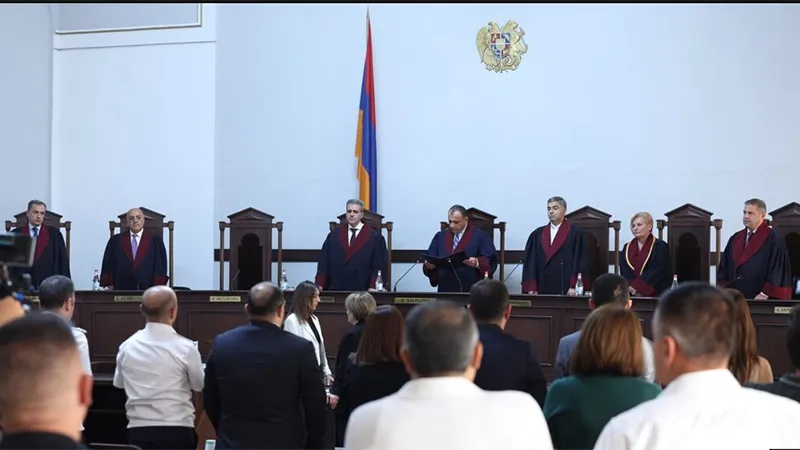
"Violations have either not been proven, or their scale and impact cannot cast doubt on the legitimacy of the elections," Constitutional Court.
10-07-2026 19:46 Armenia Press of Diaspora
azatutyun.am The Constitutional Court, in publishing its extensive decision regarding the election results, concluded that the irregularities recorded during the June 7 elections, including cases of abuse of administrative resources, did not affect the outcome.
“They say, ‘yes, it’s bad, it shouldn’t be, this is interference, but we can’t measure the outcome,’” said lawyer Hovhannes Khudoyan in an interview with “Liberty.”
Seven opposition forces appealed to the Supreme Court. The lawyer of the “Armenia” alliance led by former president Robert Kocharyan, Khudoyan, claims that the Supreme Court essentially accepted their observations regarding the violations, but did not go all the way and made a decision that was not legal, but rather political.
“They performed mental gymnastics, went halfway—agreeing in some cases, disagreeing in others—but if they had gone all the way and properly assessed the evidence, they should have concluded that there were measurable impacts on the election results. They did not take that last step because if they had, they would have been forced not to make that political decision,” emphasized the lawyer.
The opposition's key force, the “Prosperous Armenia” led by Gagik Tsarukyan, argued during the week-long hearing that if the Central Electoral Commission did not recognize the results of two polling stations as valid, they would have crossed the 4 percent threshold and entered parliament. They also noted that they would have had a positive outcome if a re-vote had been organized at those polling stations.
However, the Supreme Court made the same assertion as both the Central Electoral Commission and the representatives of the ruling “Civil Contract” party recognized as a third party in the Constitutional Court. The court concluded that it was not convinced by the recording of such violations when summarizing the election results that could have affected the overall results of the elections and served as a basis for a re-vote.
“I compared this more to the position of the CP that ‘we believe that no one voted there, therefore it is impossible to calculate,’” noted Khudoyan.
In its 193-page decision, the Supreme Court allocated a special section to the factor of abuse of administrative resources raised by the opposition, particularly the unexpectedly increased pensions before the election campaign.
“And regarding this, it was also said that ‘although it is undesirable to use these pension increases and other things as a propaganda trick, we cannot measure its impact on the elections either.’ It turns out that they agreed with the applicants on significant circumstances, but in the section where they should have assessed the impact, they avoided making an assessment, ignoring that evidence,” said lawyer Khudoyan.
While the opposition presented cases of the ruling party using state resources as a propaganda tool and claimed that it affected the will of the voters, the Constitutional Court reached the opposite conclusion but also issued several recommendations.
“At the national level, to refrain from such increases in expenditures directed at the implementation of social programs that, in light of their proximity to the election day, significantly contradict the previously announced programs and other circumstances, can reasonably be assessed as ‘social bribery.’
The Supreme Court also referred, without naming specific individuals, to the privileges granted by the CP mayor of Talin during the election period.
“At the level of local self-governance, to refrain from granting such privileges by community leaders representing the ruling political force or a force that has formed a political alliance with it, which, in light of their proximity to the election day, can reasonably be assessed as ‘social bribery.’
The Constitutional Court published the concluding part of its decision last Saturday. The court upheld the decision of the CEC regarding the June 7 elections.
According to the CEC decision, the ruling “Civil Contract” party of Nikol Pashinyan, Samvel Karapetyan’s “Strong Armenia,” and Robert Kocharyan’s “Armenia” opposition alliances are entering the new parliament.
* This text was automatically translated by Artificial Intelligence (AI).


 ENGLISH