Armenia is appearing on the economic map of the Persian Gulf.
21-09-2026 15:43 Politics
1in.am On the occasion of Armenia's Independence Day, the Omani Oman Observer has dedicated an extensive publication to the Armenia-Oman relations. This time, the newspaper, operating under the Omani Ministry of Information, presents Armenia from a broader economic perspective, highlighting trade, tourism, logistics, and Armenia's potential role in regional communications.
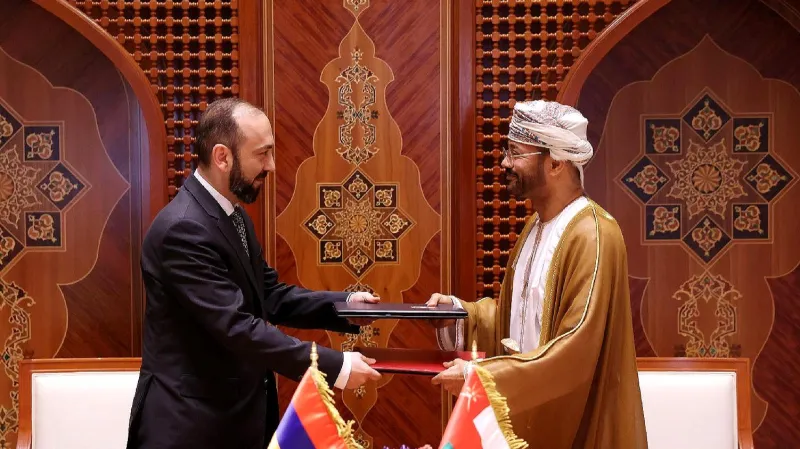
Oman was the first Arab state to establish diplomatic relations with Armenia in 1992. In March 2026, Armenia's permanent embassy was officially opened in Muscat with the participation of the foreign ministers of both countries. Yerevan linked the opening of the embassy to the expansion of economic cooperation, the revitalization of trade relations, and new opportunities for practical relations.
Now, the economic directions of the relations are becoming clearer. Oman Observer highlights the growth of trade, the entry of Armenian agricultural products into the Omani market, mutual visa facilitation, and the prospect of establishing direct air communication between Yerevan and Muscat. The publication also mentions renewable energy, information technology, and logistics as the next areas of cooperation.
However, the most important emphasis of the publication is on transport connectivity. Oman Observer examines the Washington process of August 8 and TRIPP in the context of expanding regional communications, emphasizing the interest of the Persian Gulf in the emerging new infrastructural routes. Oman was also one of the first countries to welcome the agreements reached in Washington.
This is an important episode in the new geopolitical environment forming around Armenia. Decades of closed borders, interrupted railway connections, and the dominant role of the Russian market have predetermined the scope of Armenia's economic opportunities. Now, new communication projects are gradually expanding that scope.
Armenia could find itself at the center of a system that connects the Persian Gulf, the Black Sea, and the Caspian region. Such connectivity provides the country with not only a transit role but also a broader economic and strategic role.
The idea of a Persian Gulf-Black Sea route has a long history. Armenia and Iran have long discussed the possibility of transporting cargo from Iran's southern ports to the Black Sea via Armenia and Georgia. In this chain, Chabahar and Bandar Abbas could connect to Georgian ports through Armenia, and from there to European markets.
Oman holds a special place in this emerging system. The ports of Salalah, Sohar, and Duqm, located near the Strait of Hormuz, have made the country one of the major logistics hubs connecting Asia, Africa, and the Middle East. For this reason, Armenia-Oman transport cooperation could gain much broader geopolitical significance beyond bilateral relations.
Cargo from Omani ports can reach Armenia through Iran, then to Georgia and the Black Sea. The launch of TRIPP could also connect this chain to the Caspian Sea and Central Asia. In that case, Armenia would find itself at the intersection of two major communication routes: from the Persian Gulf to the north and from the Caspian region to the west.
At this moment, we are still talking about a route that is being formed. There are infrastructural gaps, issues with border and customs procedures, limitations on road capacity, railway segments needing restoration, and regional political risks. The Omani publication does not record a new transport agreement; it shows the direction of cooperation and its potential geopolitical value, but the political geography often changes even before the language. States begin to see each other in different roles, which is followed by investment, infrastructure, and trade.
The opportunity opening up for Armenia is to become a necessary link between regional flows. The Persian Gulf, the Black Sea, the Caspian region, and European markets through Turkey could create an interconnected communication environment around Armenia.
The Omani publication is valuable precisely from this perspective: it views Armenia in the context of broader regional movements.
If these opportunities are strengthened by roads, railways, air communication, and stable trade flows, Armenia's geographical isolation could gradually turn into a connectivity advantage.
* This text was automatically translated by Artificial Intelligence (AI).


 ENGLISH