1in.am On June 21, the Iranian-American "technical negotiations" began in the Swiss resort town of Bürenstuck. The Prime Minister of Pakistan, Sharif, and the Foreign Minister of Qatar, al-Thani, also arrived in Bürenstuck. The Israeli outlet Vesty reported that the American delegation was led by Vice President Jay D. Vance, while the Iranian delegation was headed by Parliament Speaker Ghalibaf. However, the latter was not present in the negotiation room.
The Israeli media quoted Vice President Vance's opening remarks: "In the last few hours, we have made significant progress. The question is whether we can change the situation in the Middle East forever," he said, specifying that Iran "has been a source of regional instability, and President Trump has asked to open a new page and radically change our relations with the Iranian people."
While Iran and the United States are expected to engage in at least a sixty-day diplomatic "marathon"—if, of course, the Bürenstuck meeting secures "technical agreements"—several Azerbaijani state media outlets have simultaneously addressed an interview given a few days ago by the former Iranian ambassador to Azerbaijan, now responsible for the protocol in the presidential administration, Musavi, where he highly valued relations with Armenia and expressed doubt about whether "it is known whether the American entities involved in the works at the Iranian border are civilian or military."
Three Azerbaijani media outlets—Haqqin, Minval Politika, and Oxu.az—have disseminated the opinion of political scientist Gabil Huseynli, who stated that "what Azerbaijan warned about is becoming a reality; Armenia has deployed European observers at the border with Iran, and Tehran would have no doubts if it had accepted Baku's justifications in time." What "justifications" Azerbaijan had can be speculated.
But it is more "sensitive" why, while publicly advocating for the "prompt implementation" of the TRIPP project, the Azerbaijani side has so "warmly accepted" the "concerns" of the former Iranian ambassador in Baku. Apparently, Azerbaijan's real concern is the possible "deal" between Iran and the United States.
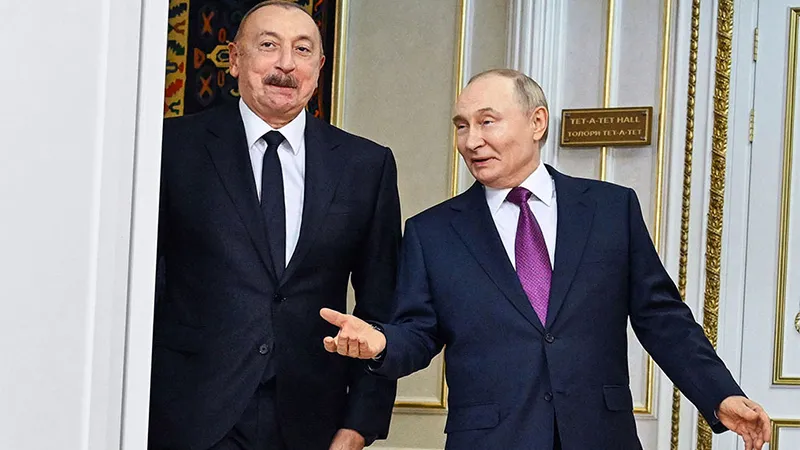
If it materializes, it is highly likely that "Iranian concerns related to TRIPP will largely be alleviated," and Azerbaijan will lose its status as "the only strategic ally of the United States" in the Caspian-Black Sea basin, thus missing the opportunity to gain "hegemonic status" in the South Caucasus. If Aliyev is convinced that there will be "no single support" from the U.S., will he "return to Putin's embrace" for that role? The radical opposition in Armenia is uniting to "prevent the country's capitulation." But what kind of "capitulation" is Azerbaijan deeply regretting?
* This text was automatically translated by Artificial Intelligence (AI).




 ENGLISH
  Հայերեն
 Русский
 Արեւմտահայերեն
 French