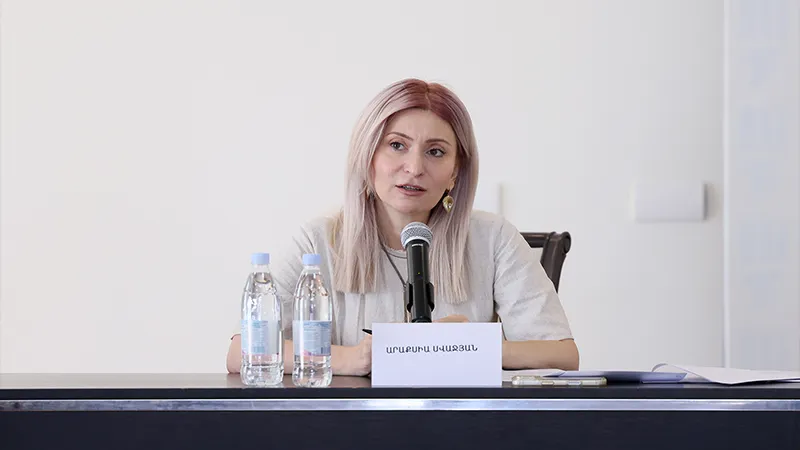
Consultation with college directors in preparation for the new academic year
27-08-2026 18:44 Armenia
At the start of the new academic year, the Deputy Minister of Education, Science, Culture and Sports of the Republic of Armenia, Araksia Svajyan, met with the directors of vocational educational institutions to discuss issues related to the organization of the educational process and the changes being implemented and planned in the vocational education sector.
The discussion was also attended by the head of the Vocational Education and Training Department of the Ministry of Education, Science, Culture and Sports, Gayane Arzumanyan, and representatives from other sectoral organizations.
Over the past five years, the number of students admitted to the vocational education system has increased by about 45 percent.
The Deputy Minister presented the preliminary results of admissions to vocational education institutions. According to her, if around 11,000 students were admitted to the system in the 2021-2022 academic year, this year the preliminary figure is 16,738. Thus, over the past five years, the number of admissions has increased by about 45 percent, indicating that state policy has contributed to the attractiveness of the sector.
Analyses show that one in three students completing basic school continues their education in vocational education institutions. In this regard, the Deputy Minister emphasized the importance of working on students' vocational orientation starting from the 8th grade, also highlighting the active role of colleges.
Colleges are encouraged to activate non-formal educational programs.
Araksia Svajyan drew the attention of college directors to the potential for developing non-formal educational programs. Within the framework of the social credit system, citizens have the opportunity to receive up to 100,000 drams in income tax refunds annually for participating in educational programs. Currently, the number of guaranteed programs has reached 2,099, of which 1,244 were guaranteed only in 2026.
However, the vast majority of programs have been presented by the private sector, while the participation of colleges remains limited. The Deputy Minister suggested that colleges consider this opportunity as a tool for attracting extra-budgetary resources by developing training programs for which institutions have the professional and material resources.
The certification of lecturers will continue.
Regarding the professional development of lecturers, Araksia Svajyan noted that in 2024, 276 specialists were certified, and in 2025, 181 specialists. Certification is preceded by training, and about 90 percent or more of potential participants successfully pass the certification. In the case of a positive result, the salary increases to 200,000 drams, to which a 30-50 percent bonus is applied based on the points collected. This year, new fields have been included for certification, including the operation and repair of vehicles, organization and management of transportation, winemaking, dairy technology, electrical installations, and more.
174 lecturers teaching general education subjects in colleges have voluntarily undergone certification and receive an increased salary.
The Deputy Minister called on directors to encourage other lecturers to also participate in voluntary certification.
Another direction of professional development is the granting of ranks. In the field of vocational education, eight lecturers have already received ranks, while two educators in general education subjects have also received ranks.
30 colleges will be built, reconstructed, and renovated.
According to the Deputy Minister of Education, Science, Culture and Sports, the presence of modern infrastructure and material-technical base is also one of the important prerequisites for quality vocational education. The new government program plans the construction, reconstruction, and renovation of 30 colleges, which will be fully equipped with new furniture and modern material-technical resources.
During COP17, colleges in Yerevan will not hold in-person classes for two weeks.
Araksia Svajyan also addressed the upcoming events of the 17th Conference of the Parties to the Convention on Biological Diversity (CBD COP17), which is scheduled for the last two weeks of October, during which Armenia plans to host thousands of delegates.
During this period, in-person classes will not be organized in schools and colleges in Yerevan, but the planned educational process must be completed and properly organized.
A conference on the vocational education sector will be held in the autumn.
Araksia Svajyan also informed that a workshop dedicated to the vocational education sector is planned for this autumn, which will serve as a platform to jointly discuss existing problems in the sector, successful experiences, and development opportunities.
Several legal changes are planned in the vocational education sector.
According to Araksia Svajyan, the regulations on licensing and accreditation, as well as the financing of colleges, are being completely revised and are currently in the development phase. The adoption of other legal acts is also planned, in accordance with the requirements of the Law of the Republic of Armenia on "Vocational Education and Training."
It was noted that the National Center for the Development of Vocational Education and Training (NCDVET), which previously operated under the National Center for Educational Development and Innovations (NCEI), will now function as a separate foundation. The newly established structure will operate in three main directions: the development of vocational education and its content, the improvement of professional skills in non-formal education, and the development of cooperation with employers.
At the end of the meeting, the Deputy Minister answered questions from college directors regarding the new financing system for vocational education institutions, the digitization of the system, the implementation of educational programs in accordance with labor market demands, the provision of scholarships for priority specialties, the application of the ChatGPT Edu tool, and several other issues.
* This text was automatically translated by Artificial Intelligence (AI).


 ENGLISH