1in.am A technical news item from Baku is actually a political statement about the future of the South Caucasus.
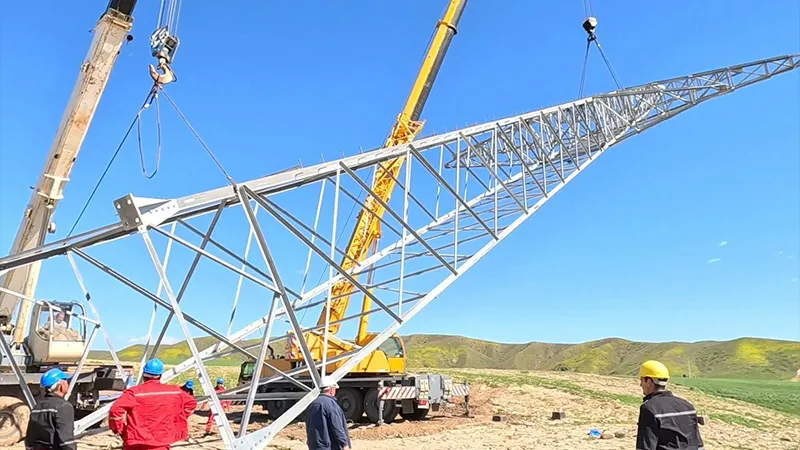
«Azerenerji» has completed the design of the power transmission line from the Armenia-Azerbaijan border to Nakhchivan. The 74-kilometer, 330-kilovolt double-circuit line being constructed from Jabrail to the Armenian border is almost ready. A site has also been allocated in Nakhchivan for a converter substation, which is expected to become one of the key hubs for future electrical connections between Azerbaijan and Turkey. Baku explicitly links this entire system to the energy component of TRIPP.
In other words, after roads and railways, electricity also appears on the TRIPP map, and this could be much more important than it seems.
The geopolitics of the 20th century was built around oil pipelines. One of the important infrastructures of 21st-century geopolitics will be the electricity grid. Digitalization, artificial intelligence, data centers, electric transport, and renewable energy turn electricity into not just a commodity but also a strategic connection.
The pipeline connected the mine to the market. The electricity grid can connect entire regions to each other.
Baku is already considering this in that logic. Azerbaijan's Minister of Energy Parviz Shahbazov states that the goal is to complement the East-West energy system built around oil and gas between Azerbaijan and Turkey with electricity and green energy corridors, delivering energy from the Caspian Sea and Central Asia to Turkey and European markets.
In this map, Armenia is no longer just the territory that separates the main part of Azerbaijan from Nakhchivan—it can become the hub that connects them. For thirty years, one of Armenia's biggest geopolitical problems was being landlocked. Closed borders deprived Armenia not only of routes but also of the economic value of geography. The territory existed, but transit did not. Armenia was located between the East and the West, but that position could not be turned into capital.
The real significance of TRIPP lies here. If a railway, a highway, digital connections, and later also power lines pass through Armenia, then the country's geography begins to work in its favor, but here Armenia needs a fundamental distinction—Armenia should not just be the territory through which Azerbaijan connects to Nakhchivan and Turkey. Armenia must be a full participant in that regional energy system. These are completely different economic models.
In the first case, Armenia has a line in its territory and receives some transit revenue. In the second case, the Armenian energy system connects to the systems of Azerbaijan and Turkey, allowing it to buy, sell, exchange, and transport electricity in various directions.
Prime Minister Nikol Pashinyan already spoke about this logic in January of this year, proposing to connect Armenia's energy system to those of Turkey and Azerbaijan. His argument was that this would open larger markets for Armenia, and interdependence would become an additional guarantee of security. This is a much more serious vision of peace than many statements.
If Azerbaijan connects to Nakhchivan and Turkey through Armenian territory, and Armenia does not receive equivalent access to regional markets, it creates not interdependence but one-sided transit. Therefore, Armenia's negotiation issue should not only be the conditions for the line's passage but also its own place in the entire energy architecture.
Armenia already has electrical connections with Iran and Georgia. Connecting to Turkey and Azerbaijan could theoretically turn it into an energy hub operating in four directions. In that case, Armenia could not only export its own products but also participate in regional electricity exchange and transit. Here, the global economy begins to change geopolitics.
For decades, Armenia's main principle of energy security was isolation—having its own production and being as little dependent as possible on conflicting neighbors. That was the logic of a war-torn region.
The logic of a peaceful region is the opposite—to have as many connections, suppliers, markets, and directions as possible.
Security is sometimes a wall, and sometimes security is having many doors.
However, there is also a cautionary aspect in Baku's statement. The term «Zangezur corridor» continues to be used in the Azerbaijani official vocabulary, while the basis of TRIPP is Armenia's sovereignty and jurisdiction. Therefore, infrastructural integration should develop not at the expense of sovereignty but rather on the basis of mutual interests of sovereign states. This is the boundary where economic opportunity meets political responsibility.
Baku is already designing the line. A site is already being allocated for the substation in Nakhchivan. Turkey and Azerbaijan are discussing the future line for interconnecting their electrical systems, meaning the future energy map of the region is ceasing to be a theory and is starting to turn into an engineering project.
Armenia's problem now is not just to provide a route on that map. Our problem is to become a hub because transit territory earns rent from its geography. A hub state transforms geography into influence, and if TRIPP can turn Armenia from a country between closed borders into a crossing point for roads, railways, data, and electricity, then its greatest achievement may not even be the connection between Azerbaijan and Nakhchivan.
It will be the return of Armenia's geography to the Armenian economy.
* This text was automatically translated by Artificial Intelligence (AI).


 ENGLISH