Breaking Old Guards: Armenia's Shifting Geopolitical and Military Landscape
26-06-2026 14:00 Հայաստան Հարցազրույցներ
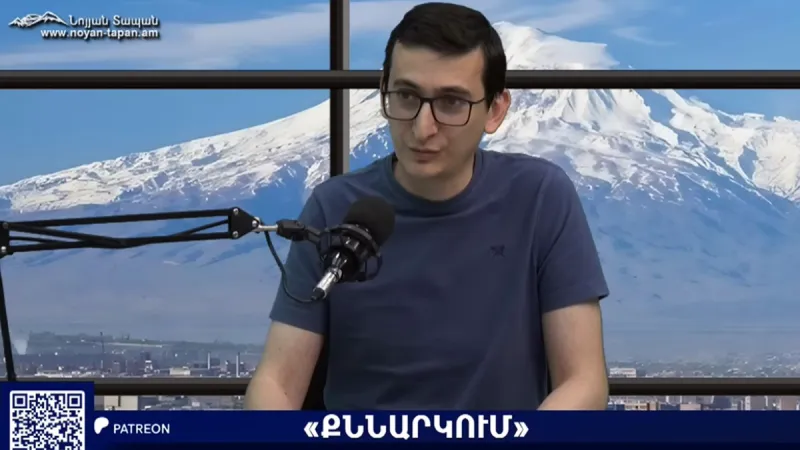
In a comprehensive interview broadcast by Noyan Tapan, host Gayane Arakelyan sat down with Leonid Nersisyan, Senior Fellow at the APRI Armenia research center and military-political expert. The discussion explored the deteriorating relations between Armenia and Russia, the stagnation of regional formats, and the sweeping reforms modernizing Armenia’s defense architecture.
The Rhetoric of Fear vs. Geographical Reality
The conversation began by addressing recent statements from Moscow. Russian Foreign Ministry spokesperson Maria Zakharova claimed that the joint "Eagle Partner" military exercises in Armenia were designed by NATO to train Armenian soldiers to "fight against Russia".
Nersisyan dismissed the claim as purely political pressure and propaganda. "One can simply open a map, look at where Armenia and Russia are located, and understand that Armenia cannot even wage a war against Russia," Nersisyan remarked, noting that the two countries do not share a border. "Aside from the fact that it is an absurdity from a resource standpoint, it is simply not possible."
According to the expert, the exercises were standard peacekeeping maneuvers. However, this iteration featured an expanded format, incorporating military components from Greece and France.
"All of Armenia’s most active Western partners are now participating together in these exercises, which is quite positive," Nersisyan noted.
Regarding Moscow's warnings that Armenia could lose its voting rights in the Collective Security Treaty Organization (CSTO) over unpaid membership fees—or be expelled entirely—Nersisyan remained unphased. Since Yerevan has already frozen its participation and abstains from meetings, any official sanction would have zero practical impact. Paradoxically, expelling Armenia would damage the CSTO more than Yerevan.
"It will simply mean that the final decision to leave was made by Russia rather than Armenia," Nersisyan stated, emphasizing that the current downward trend in bilateral ties is driven by Russia's resentment toward nations pursuing multi-vector foreign policies.
The Rise of Domestic Defense and Shifting Paradigms
A significant portion of the interview centered on Armenia's military modernization and its participation in Paris's Eurosatory 2024—one of the world's largest defense exhibitions. Armenia featured a substantial pavilion, signaling a growing capacity to showcase domestic military hardware.
A milestone partnership was struck when an Armenian defense enterprise signed a strategic cooperation agreement with a major French defense firm. Nersisyan noted that the domestic defense sector is experiencing serious growth. If maintained for the next few years, it could become a vital economic and political component of statecraft.
While specific details regarding Armenian weapons exports remain confidential, Nersisyan highlighted the sectors driving domestic production:
•UAV development and electronic warfare (EW) systems.
•Multi-caliber ammunition and tactical artillery.
•Modernized rocket systems and self-propelled mortars.
The expert also touched upon the deep structural changes within the military's education system. Since 2022, Armenian officers have stopped training in Russia, pivoting instead to academies in France, Greece, and the United States. This offers a stark contrast to Azerbaijan, whose officer corps has been deeply integrated into Turkey's NATO-standard system since the 1990s.
Regional Formats and Deficit of Balance
When asked about the "3+3" regional format—involving the three South Caucasian states and their neighbors (Russia, Turkey, Iran)—Nersisyan voiced skepticism. Despite recent diplomatic engagements between Moscow and Ankara, the expert argues the format is an unstable mathematical equation.
"3+3 equals five, not six," Nersisyan joked, referencing Georgia's continuous refusal to join any platform that includes Russia. Furthermore, the remaining regional powers hold conflicting views on the South Caucasus. For instance, Iran actively worked to disrupt the regional transport corridor projects pushed by Russia and Azerbaijan between 2021 and 2022. The primary goal of the format, Nersisyan asserted, is simply to exclude the US and EU from the region—a goal not uniformly shared or prioritized by all participants.
Ultimately, Nersisyan emphasized that real peace is maintained through a balance of power, not pieces of paper. "No document has ever been a 100% guarantee in history," he concluded, urging Armenia to focus on making any future foreign aggression costly and impossible to execute. Derived from recent global conflicts, he advocated for decentralized command structures and the utilization of Armenia’s mountainous terrain to build protected underground military infrastructure.


 ՀԱՅԵՐԵՆ