The case of Bishop Gevorg. The question that remained behind closed doors.
19-09-2026 17:25 Armenia Politics
1in.am In the first session of the trial of Garegin II and six high-ranking clergymen, the most resonant statement was about the Prime Minister, with lawyer Ara Zohrapyan declaring that the Prime Minister of Armenia does not have the authority to appoint or dismiss a bishop.
Legally, this is an indisputable starting point. The Constitution of Armenia separates religious organizations from the state and guarantees their freedom of activity. The same Constitution recognizes the unique mission of the Armenian Apostolic Church in the spiritual life of the Armenian people. The Prime Minister does not appoint bishops, the government does not confer ecclesiastical ranks, and the state body cannot determine the content of ecclesiastical law or revise the canonical decisions of spiritual authority.
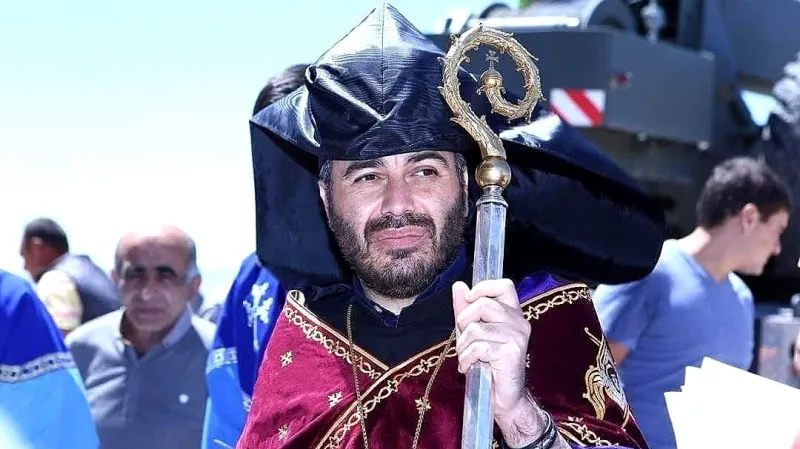
But the real crux of this case is not the Prime Minister. The crux is Gevorg Saroyan.
Saroyan is not a secular politician who has left the church. He has lived within that system for many years, led a diocese, held the rank of bishop, and then challenged the method of governance from within, which he considers an expression of the politicization of the church. On September 18, he reiterated that the reason for his rebellion is the danger of the church becoming a political tool of parties or external forces. The Mother See has published entirely different justifications for his removal: neglect of official duties, pressure on clergymen, disobedience, and disruption of the diocese's work.
It is this contradiction that makes the case significant. On January 10, Saroyan was dismissed from the position of the head of the Ararat Diocese. He appealed to the civil court because there is no opportunity to contest that arbitrary decision within the church. On January 16, the court ordered the church not to obstruct his tenure and the execution of the diocese's financial powers until the final judicial act. On January 27, by the directive of Garegin II, Saroyan was declared defrocked. The current prosecution by the prosecutor's office is related to the alleged obstruction of the execution of that interim court act.
Here, two legal principles clash with each other: the first is ecclesiastical autonomy. The case law of the European Court is very strict on this issue. The autonomous existence of a religious community is considered a fundamental component of religious freedom, and the state is obliged to maintain neutrality and impartiality. The Strasbourg court has even assessed state support for one of the internal church parties in the dispute over the Bulgarian Orthodox Church as a violation of Article 9 of the Convention. This is a serious argument for the defense. The state cannot decide the canonical validity of an ecclesiastical rank on behalf of the Catholicos.
But Saroyan's case does not end there. His position also has legal, property, and administrative implications. The head of the diocese manages accounts, conducts financial transactions, and oversees important directions of the legal entity's activities. The court's decision in January was precisely to temporarily protect those powers until the main claim was examined.
Here, a much more difficult question arises for Armenia. At what point does the boundary of religious autonomy meet the citizen's right to judicial protection? The answer to this question cannot be given by a political statement and cannot be closed with the formulation of "the church's internal affairs." Ecclesiastical autonomy does not eliminate legal responsibility, and the civil court cannot assume the functions of ecclesiastical authority.
The value of Bishop Gevorg Saroyan's case lies in making this boundary visible. He has also raised a more uncomfortable question in court: what real means of protection does a clergyman with disagreements within the church have? The Mother See insists that Saroyan has violated the vow of obedience and ecclesiastical discipline. Saroyan responds that the internal courts do not function, and his complaint arose from a rebellion against the politicization of the church.
This question is much deeper than any bishop's position. Closed systems can maintain the impression of external unity for a long time, but that image often conceals accumulated discontent and deepening contradictions within. A viable institution does not escape these; it has the ability to listen to, examine, and provide convincing answers to the questions raised from within.
For the Armenian Church, Bishop Gevorg Saroyan is precisely that test. All his claims in court may not be substantiated. Each of his actions does not automatically become lawful. The same standard applies to the Mother See. The existence of canonical authority does not itself answer questions raised about possible arbitrariness, internal accountability, or political involvement.
This trial should not be narrowed down to the simplistic opposition of "Pashinyan vs. the Catholicos." At the center of the case is a person who has contested the decision of his superior within the church, appealed to the civil court, and received temporary judicial protection. After that, the ecclesiastical authority stripped him of his rank, while the state initiated criminal proceedings based on the alleged non-fulfillment of the judicial act.
Each link in that chain requires separate legal examination, and it is here that the court's responsibility becomes historical.
The court should not decide who is the "real" bishop. Its task is much clearer: to define the legal boundaries of state intervention, to ensure the mandatory force of the judicial act, and to maintain the autonomy of the church without turning the court into a substitute for ecclesiastical authority and the church into a privileged territory over civil law.
Bishop Gevorg Saroyan's case is no longer just a personal dispute of one clergyman. Through this trial, Armenia is defining the boundaries of the rule of law in relation to the church—how far the state can go and how far the church can go.
* This text was automatically translated by Artificial Intelligence (AI).


 ENGLISH