Beyond Stereotypes and Sentiments: How Armenia Can Navigate Russia, Turkey, and Iran
26-06-2026 17:15 Հայաստան Հարցազրույցներ
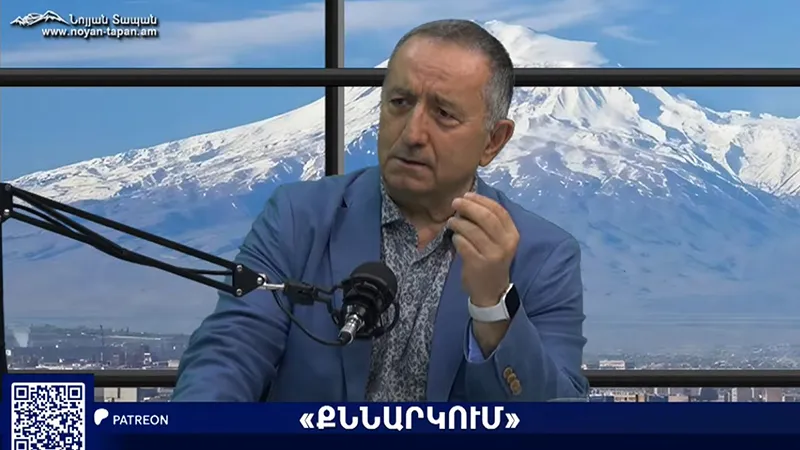
In an era defined by shifting geopolitical tectonic plates, Armenia finds itself navigating a perilous diplomatic landscape compressed between old empires and emerging regional giants. In a recent broadcast on Noyan Tapan, diplomat and former head of the UN Development Programme in Syria, Davit Hakobyan, dissected the complex regional dynamics involving Russia, Turkey, and Iran, offering a roadmap for Armenian sovereignty.
The "Big Brother" Syndrome and the Strategic Freeze with Russia
The conversation opened with Russia’s renewed demands for Armenia to clarify its intentions regarding its membership in the Collective Security Treaty Organization (CSTO). Russian Permanent Representative Victor Vasilyev recently pushed Yerevan to declare whether it plans to remain or pursue alternative scenarios.
Rejecting the notion of any immediate bid for NATO membership, Hakobyan argued that maintaining a "frozen" status within the CSTO remains Armenia's most pragmatic short-term path. However, his long-term vision leans toward structural sovereignty.
"My proposed scenario is for us to declare neutrality—establishing equidistant, multipolar relationships in both economic and security spheres," Hakobyan stated. "Even if we exit the CSTO, it should not be framed as an act against Russia, but as a step toward normal, neighborly relations as equal partners."
Hakobyan attributed Moscow's aggressive rhetoric to a deeply ingrained "big brother syndrome," a post-Soviet imperial reflex where Moscow expects former republics to remain subservient. He pointed out that while Central Asian states like Kazakhstan and Kyrgyzstan actively sign sweeping agreements with the European Union without triggering public outbursts from Moscow, Armenia is uniquely targeted as the perceived "weakest link" in a geopolitical "jealous husband syndrome."
Turkey’s Rational Expansionism vs. Historical Stereotypes
Turning to the West, the interview addressed Ankara's growing footprint in the South Caucasus. Unlike Russia’s blunt, heavy-handed tactics, Hakobyan described Turkish diplomacy as cautious, highly calculated, and consistently expansionist. This expansion spans from military bases in Somalia and political maneuvers in Sudan and Libya to its deep involvement in Syria and economic overtures toward Central Asia.
Reflecting on the 2020 Nagorno-Karabakh war, Hakobyan clarified that Turkey’s heavy backing of Azerbaijan was an independent projection of Ankara's ballooning economic and military capabilities, rather than a NATO-driven operation. With Turkey's economy projected to approach the size of Russia's within the decade, Armenia must adjust its lens.
"We must free ourselves from the absolute stereotype that Turkey is merely a force of pure evil and that any interaction will yield only negative consequences," Hakobyan urged, advocating for a cold, rational approach.
Ankara, according to the diplomat, is a bridge to the European Union market. The opening of transit routes through Turkey could fundamentally simplify Armenia's access to Western trade. Yet, this economic pragmatism must not blind Yerevan to structural threats. Citing Syria as an example—where Turkey introduced its currency and appointed governors in northern regions—Hakobyan warned that economic dominance can quickly morph into political subjugation if left unchecked.
To prevent economic integration from turning into a corporate annexation, Hakobyan stressed that Armenia must work with international allies to solidify its sovereignty as an immutable "red line."
Iran: The Quiet Neighbor Recognizing Red Lines
Among the trio of historically imperial neighbors, Iran emerged in the discussion as the most stable and respectful of bilateral boundaries. Hakobyan recalled highlighting this unique dynamic during a conference in Tehran.
"Massive Iran is surrounded by twelve neighbors, and Armenia is its only non-Muslim neighbor. Yet, we have never experienced pressure from them to expand into our territory, suppress us, or impose their ideology," he remarked.
Tehran's primary concern remains purely defensive: ensuring that neither Armenia nor Azerbaijan becomes a launching pad for Western or Israeli military intelligence. Amid reports of a significant Israeli presence in Azerbaijan, maintaining a transparent and secure border with Armenia is a critical security imperative for Iran.
Furthermore, Hakobyan noted that impending geopolitical shifts—such as the potential unfreezing of $100 billion in Iranian assets and massive foreign investment waves—could turn Iran into an economic powerhouse. Armenia's infrastructure projects, particularly those connecting North-South and East-West corridors, must be framed not as anti-Iran or anti-Russia vectors, but as vital, collaborative economic networks.
The Path Forward
As empires old and new seek to balance their books at the expense of smaller states, Armenia’s survival strategy relies on institutional agility. By diversifying security partners through deep cooperation with the European Union and the United States, while maintaining rational, un-emotional economic ties with regional giants, Yerevan can protect its statehood. The lesson from Hakobyan’s analysis is clear: in the theater of South Caucasian geopolitics, sentimentality must be entirely replaced by cold, calculated strategy.


 ՀԱՅԵՐԵՆ
 Русский
 English
 Արեւմտահայերեն
 French